
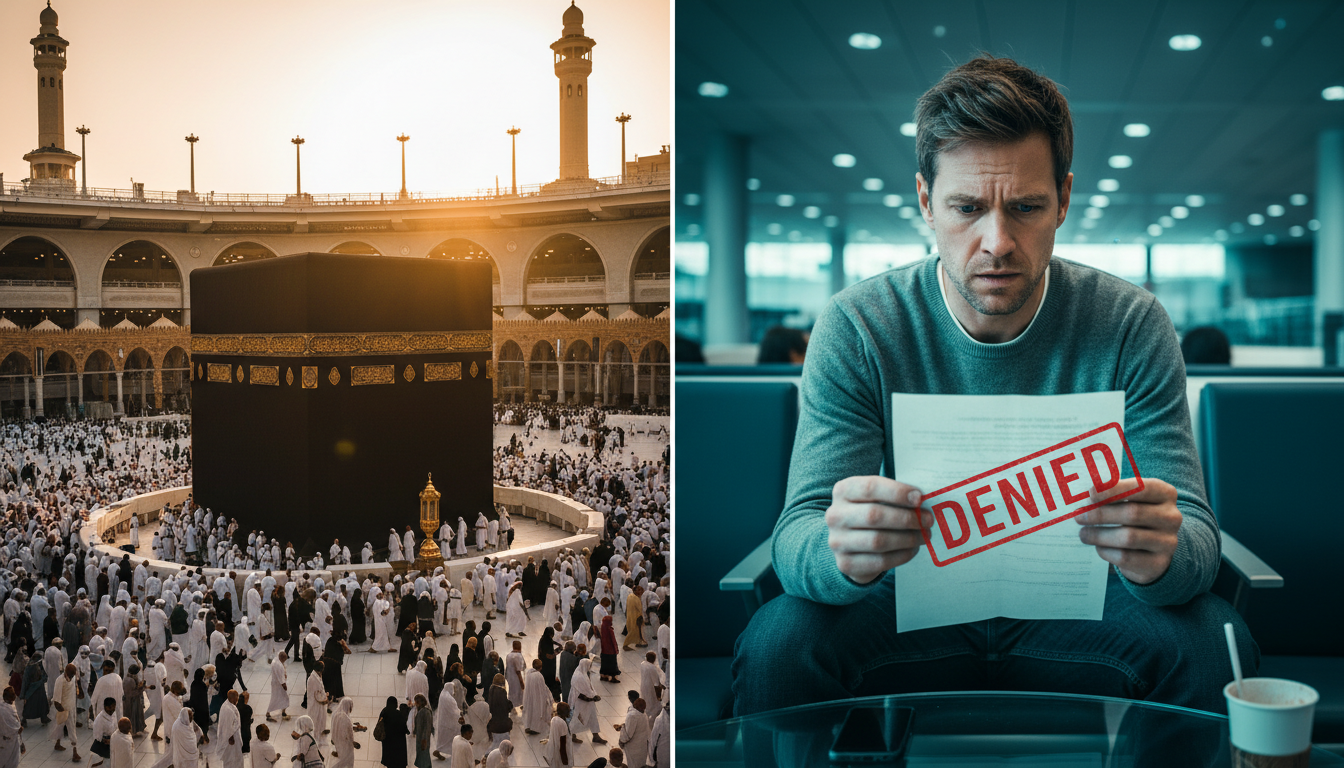
When planning your spiritual journey to the Kingdom, asking is mandatory Saudi visa insurance enough is arguably the most critical financial question a US pilgrim can ask before boarding the plane. For thousands of American Muslims embarking on Umrah or Hajj, the assumption that the government-issued insurance included with the visa fee is a “catch-all” safety net is a dangerous misconception that could lead to financial ruin.
While the Kingdom of Saudi Arabia has made great strides in modernizing its tourism and pilgrimage infrastructure, the insurance policy attached to your electronic visa is basic at best. It is designed primarily to protect the local healthcare system from unpaid bills, not to protect your personal life savings. In this deep dive, we expose the gaps in coverage and explain why relying solely on this mandatory policy is a gamble no US traveler should take.
The “Basic” Nature of Mandatory Coverage
When you pay for your Saudi tourist or Umrah visa, a portion of that fee goes toward a mandatory insurance policy. Usually underwritten by local Saudi providers, this policy generally covers:
- Emergency medical treatment (up to a specific limit, often around 100,000 SAR).
- Hospitalization for emergency cases only.
- Basic repatriation of remains in the event of death.
However, what is excluded is often far more significant than what is included. For a traveler coming from the United States, where healthcare standards and expectations are high, the shock comes when a claim is denied because the condition wasn’t deemed “life-threatening” or “emergency” by local standards.
Why US Pilgrims Face Higher Risks
Travelers from the USA face a unique set of financial risks compared to pilgrims from neighboring countries. The primary factor is distance and the cost of specialized transport.
1. Medical Evacuation Costs
If you suffer a severe stroke, heart attack, or complex injury that requires you to be transported back to the United States for long-term care, the mandatory Saudi visa insurance will rarely cover the cost of an air ambulance. A medical evacuation flight from Jeddah to New York or Houston can easily cost between $100,000 and $200,000. Without supplemental insurance, this must be paid out of pocket.
2. Trip Cancellation and Interruption
Hajj and Umrah packages for US pilgrims are expensive, often ranging from $3,000 to over $15,000 per person. If you fall ill before your trip, or if a family emergency forces you to return home early, the mandatory visa insurance offers zero reimbursement for your non-refundable flight and hotel costs.
The “Hidden” Gaps in Saudi Visa Insurance
To understand why US pilgrims risk thousands, we must look at the fine print. Here is a breakdown of the critical gaps:
Pre-Existing Conditions
Many pilgrims are older individuals who may have pre-existing conditions such as diabetes, hypertension, or heart disease. Most standard mandatory policies exclude coverage for acute onsets of pre-existing conditions. If you are hospitalized due to a complication of a known condition, your claim will likely be denied.
Non-Emergency Care
If you get food poisoning that requires an IV drip but isn’t “life-threatening,” or if you twist an ankle and need an X-ray and crutches, you may be required to pay upfront at private hospitals. While public hospitals are available, the wait times during peak seasons like Ramadan or Hajj can be overwhelming.
The Financial Impact: A Hypothetical Scenario
Consider “Ahmed,” a pilgrim from Chicago. He relies solely on the mandatory Saudi visa insurance. During his stay in Medina, he slips in the hotel lobby and fractures his hip. He needs surgery and a business-class seat to fly home with his leg extended.
- Surgery in a Private Saudi Hospital: $15,000 (Covered partially by mandatory insurance, subject to deductibles).
- Flight Change & Upgrade for Leg Room: $4,000 (Not covered).
- Lost Hotel Nights: $2,000 (Not covered).
- Re-booking Companion’s Flight: $1,500 (Not covered).
In this scenario, Ahmed is out of pocket nearly $7,500, despite having “insurance.” Had he purchased a comprehensive supplemental policy for roughly $200, all of these expenses would likely have been covered.
How to Secure Full Protection
For US citizens, the recommendation is clear: treat the mandatory Saudi visa insurance as a secondary formality, not your primary safety net. You should seek a “Cancel For Any Reason” (CFAR) or comprehensive travel medical policy from a US-based provider.
When shopping for supplemental coverage, ensure it includes:
- Medical Evacuation: At least $500,000 in coverage.
- Primary Medical Coverage: So your US health insurance doesn’t have to be billed first (which often doesn’t work overseas anyway).
- Trip Cancellation/Interruption: Covering 100% of your trip cost.
- Baggage Delay/Loss: Essential for multi-leg flights.
For those looking into longer stays or combining their pilgrimage with business, you might also want to look into requirements for digital nomad visas in the region if you plan on extending your travel elsewhere.
Conclusion: Peace of Mind is Priceless
The spiritual journey of a lifetime should not be marred by financial anxiety. While the Kingdom provides a basic level of care through its visa program, the stakes are simply too high for US travelers to ignore supplemental coverage. By investing a small fraction of your trip budget into robust travel insurance, you ensure that your focus remains entirely on your worship and reflection.
Furthermore, while insurance protects your body and wallet, true preparation starts with the heart. For those seeking spiritual peace and mental wellness before embarking on this sacred journey, visit Wazifa Hub for guidance and spiritual resources.