
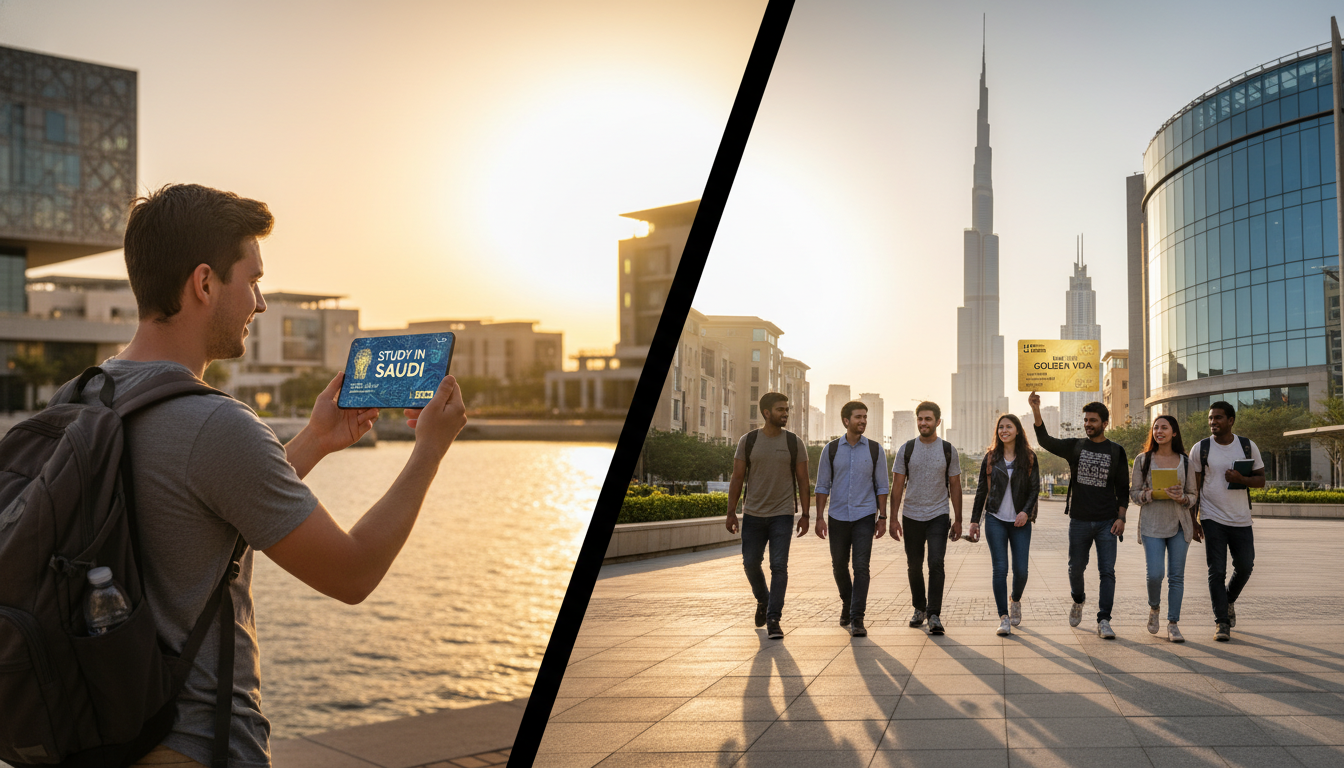
Choosing between a Saudi Arabia vs UAE student visa for Americans is becoming a pivotal decision for ambitious students looking to leverage the massive educational investments occurring in the Gulf region in 2026. As the Middle East shifts from an oil-based economy to a knowledge-based one, both nations are rolling out the red carpet for US citizens, but the ease of access varies significantly.
For decades, the United Arab Emirates (UAE) held the crown as the educational hub of the region, hosting satellite campuses of NYU, Sorbonne, and Rochester Institute of Technology. However, Saudi Arabia’s aggressive Vision 2030 initiative has revolutionized its higher education sector, introducing the “Study in Saudi” program to streamline entry for international scholars. In this comprehensive guide, we break down the paperwork, costs, and lifestyle factors to help you decide which student pathway is easier for you.
The Educational Landscape in 2026: A Quick Overview
Before diving into the visa logistics, it is essential to understand why American students are flocking to the Gulf. The region offers tax-free living (though VAT applies), state-of-the-art facilities, and proximity to emerging markets.
The UAE offers a cosmopolitan, western-friendly environment in cities like Dubai and Abu Dhabi. In contrast, Saudi Arabia offers a deeply cultural experience with rapidly modernizing cities like Riyadh and Jeddah, and tech-utopias like NEOM. For those considering a longer stay or remote work while studying, checking out requirements for a digital nomad visa in the region can also provide a backup plan for residency.
UAE Student Visa: The Established Route
The UAE has a well-oiled machine when it comes to processing visas for US citizens. Most American students applying to universities in the Dubai International Academic City (DIAC) or Abu Dhabi find the process straightforward because the university usually acts as the sponsor.
Requirements for US Citizens
- Sponsorship: You must be sponsored by an accredited university or college.
- Medical Test: A mandatory health check (blood test and chest X-ray) for HIV, Hepatitis B, and Tuberculosis.
- Financial Proof: Evidence of tuition payment and funds to support living expenses.
- Health Insurance: Mandatory coverage, often provided by the university package.
The “Golden Visa” Advantage
One of the massive draws for the UAE is the Golden Visa scheme. Outstanding students (with a GPA of 3.8 or higher) can apply for a 10-year Golden Visa, which allows for self-sponsorship and includes family members. This offers a level of stability that is hard to beat.
Saudi Arabia Student Visa: The Rising Contender
Saudi Arabia has historically been harder to enter, but 2026 marks a turning point. The introduction of the “Study in Saudi” unified platform has digitized the entire process, aiming to attract 400,000 international students by 2030.
The “Study in Saudi” Platform
This initiative allows students to apply for admission and visas simultaneously. For Americans, this removes the bureaucratic nightmare of visiting embassies. Once a university like King Abdullah University of Science and Technology (KAUST) or King Saud University accepts you, the Ministry of Education facilitates the visa electronically.
Key Differences for Americans
- Scholarships: The Saudi government offers fully funded scholarships for many American students, which often include the visa fee, housing, and a monthly stipend.
- Iqama (Residency): Unlike the UAE’s simple visa stamp, Saudi requires the issuance of an Iqama, which involves biometric fingerprinting upon arrival.
- Cultural Adaptation: While visa processing has sped up, the integration process requires more cultural awareness compared to the expat-heavy bubbles of Dubai.
Head-to-Head Comparison: Which is Easier?
When analyzing the Saudi Arabia vs UAE student visa for Americans, we must look at speed, cost, and long-term benefits.
1. Processing Speed
Winner: UAE.
Because the UAE has been doing this longer, their universities have dedicated “Visa PROs” (Public Relations Officers) who handle everything. You can often get your entry permit in 10-15 days.
2. Cost of Visa
Winner: Saudi Arabia.
If you secure a government scholarship (which is highly likely for qualified US applicants), the visa fees are waived. In the UAE, visa renewal fees occur annually unless you are on a Golden Visa, costing roughly $800-$1,000 per year.
3. Long-Term Opportunities
Winner: Tie.
The UAE offers the Golden Visa for top performers. However, Saudi Arabia represents the largest economy in the region with massive demand for English-speaking graduates in tourism, tech, and engineering.
Lifestyle and Cost of Living
While the visa is the entry ticket, your daily life matters. The UAE, particularly Dubai, is significantly more expensive than Riyadh or Jeddah. Housing in Dubai has skyrocketed, whereas Saudi Arabia still offers affordable accommodation, especially within university compounds.
Furthermore, if you are looking to explore the region during your semester breaks, having a student residence permit in either country often simplifies travel to neighboring GCC states. For those interested in high-end experiences during their breaks, exploring luxury travel options in Oman or Qatar is easily accessible from both hubs.
Conclusion: The Verdict for 2026
So, regarding the Saudi Arabia vs UAE student visa for Americans, which is easier?
If you want a hassle-free, familiar process and don’t mind paying higher fees, the UAE remains the gold standard. The infrastructure is mature, and the lifestyle is very similar to Western cities.
However, if you are looking for full funding, lower costs, and a streamlined digital application, Saudi Arabia is the winner for 2026. The “Study in Saudi” visa reforms have effectively removed the red tape that once deterred American students.
Moving abroad to study can be stressful. Navigating bureaucracy, adapting to a new culture, and managing academic pressure requires a strong mindset. For students seeking spiritual peace and mental wellness during this transition, many find comfort in meditation or spiritual practices. You can find resources for spiritual peace at Wazifa Hub.